








Beta
The Neon Data API is in Beta. Share your feedback on Discord or via the Neon Console.
Once the Data API is enabled, you can customize its behavior, manage how it authenticates users, or disable it entirely if it is no longer needed.
Manage authentication providers
Navigate to the Data API page in your project sidebar and select the Settings tab. The Authentication section lets you configure which authentication provider validates JWT tokens for your API requests.
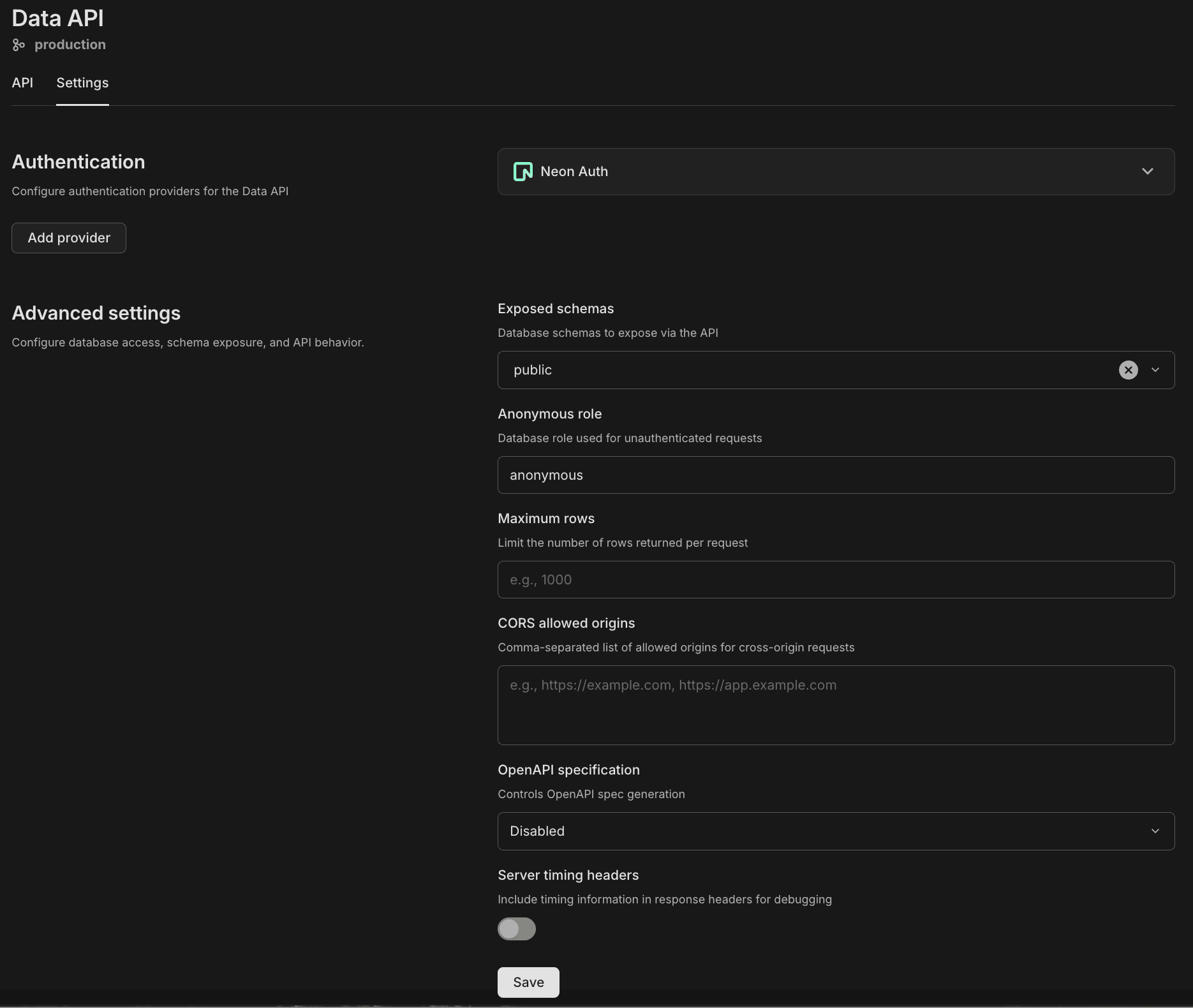
Neon Auth (Default)
When you enable the Data API with Neon Auth, it appears as the configured provider. This allows the API to trust tokens generated by Neon's authentication system. You can click on the provider dropdown to view details or switch providers.
Add or change providers
You can add, replace, or remove authentication providers. Note that only one provider can be configured at a time.
- Add a provider: If no provider is currently configured, click Add provider and enter the JWKS URL supplied by your auth service (e.g., Auth0, Clerk, or Firebase). For help finding your provider's JWKS URL, see Custom authentication providers. Some providers also require a JWT Audience value.
- Replace a provider: To switch to a different provider, remove the current one first, then add the new one using Add provider.
- Remove a provider: Use the provider dropdown menu to remove the current provider.
warning
Impact of removal: Removing an authentication provider invalidates all tokens issued by that provider. Users relying on that provider will receive 401 Unauthorized errors until they authenticate via a valid provider.
Advanced settings
The Advanced settings section on the Settings tab controls the security, performance, and behavior of your Data API endpoint.
Exposed schemas
Default: public
Defines which PostgreSQL schemas are exposed as REST API endpoints. By default, only the public schema is accessible. If you use other schemas (e.g., api, v1), select them from the drop-down list to add them.
note
Permissions apply: Adding a schema here exposes the endpoints, but the database role used by the API must still have USAGE privileges on the schema and SELECT privileges on the tables. Refer to Access control for Data API for more details.
Anonymous role
Default: anonymous
Specifies the database role used for unauthenticated requests (requests sent without an Authorization header). To allow public access to specific data, configure this role in your database using SQL GRANT statements.
Maximum rows per request
Default: Empty
Enforces a hard limit on the number of rows returned in a single API response. This prevents accidental performance degradation from large queries. Clients should use pagination limits to retrieve data within this threshold. This also prevents unexpected egress costs from large data transfers.
CORS allowed origins
Default: Empty (Allows all origins)
Controls which web domains are permitted to fetch data from your API via the browser.
- Empty: Allows
*(any domain). Useful for development. - Production: List your specific domains (e.g.,
https://myapp.com) to prevent unauthorized websites from querying your API.
OpenAPI specification
Default: Disabled
When enabled, an auto-generated OpenAPI 3 schema describing your tables, columns, and REST endpoints is available at your Data API URL with /openapi.json appended:
https://your-data-api-endpoint/rest/v1/openapi.jsonAuthentication required
Accessing the OpenAPI spec requires a valid JWT token, just like other Data API requests. Include the Authorization: Bearer header when fetching the spec:
curl -X GET 'https://your-data-api-endpoint/rest/v1/openapi.json' \
  -H 'Authorization: Bearer YOUR_JWT_TOKEN'
You can use the OpenAPI schema to:
- Import your API into Postman for easier exploration and testing
- Generate API documentation (Swagger UI, Redoc)
- Build typed client libraries (TypeScript, Python, Go)
- Integrate with API gateways and other OpenAPI-based tools
Auth API reference
If you're using Neon Auth, there's also an interactive API reference for authentication endpoints. Navigate to your Auth URL with /reference appended (e.g., https://ep-example.neonauth.us-east-1.aws.neon.tech/neondb/auth/reference). You can use this to create test users, sign in, and obtain JWT tokens for testing. See Testing with Postman or cURL for details.
Server timing headers
Default: Disabled
When enabled, the Data API includes Server-Timing headers in each response. These headers show how long different parts of the request took to process (for example, database execution time and internal processing time). You can use this information to debug slow queries, measure performance, and troubleshoot latency issues in your application.
note
After making changes to any advanced settings, click Save to apply them.
Disable the Data API
If you no longer need HTTP access to your database, you can disable the API entirely.
Scroll to the Disable section at the bottom of the Settings tab and click the Disable button.
Immediate Effect
Disabling the Data API immediately terminates all active connections and blocks all incoming HTTP requests. Any applications, edge functions, or websites relying on the API will stop working instantly.