








Beta
The Neon Auth with Better Auth is in Beta. Share your feedback on Discord or via the Neon Console.
Email verification ensures users own the email addresses they register with. Neon Auth supports two verification methods:
- Verification codes (users enter a numeric code from their email) - works with shared or custom email providers
- Verification links (users click a link in their email) - requires a custom email provider
note
Verification links require a custom email provider. If you're using the shared email provider, use verification codes instead.
Enable email verification
In your project's Settings → Auth page, enable Sign-up with Email and Verify at Sign-up. Choose your verification method.
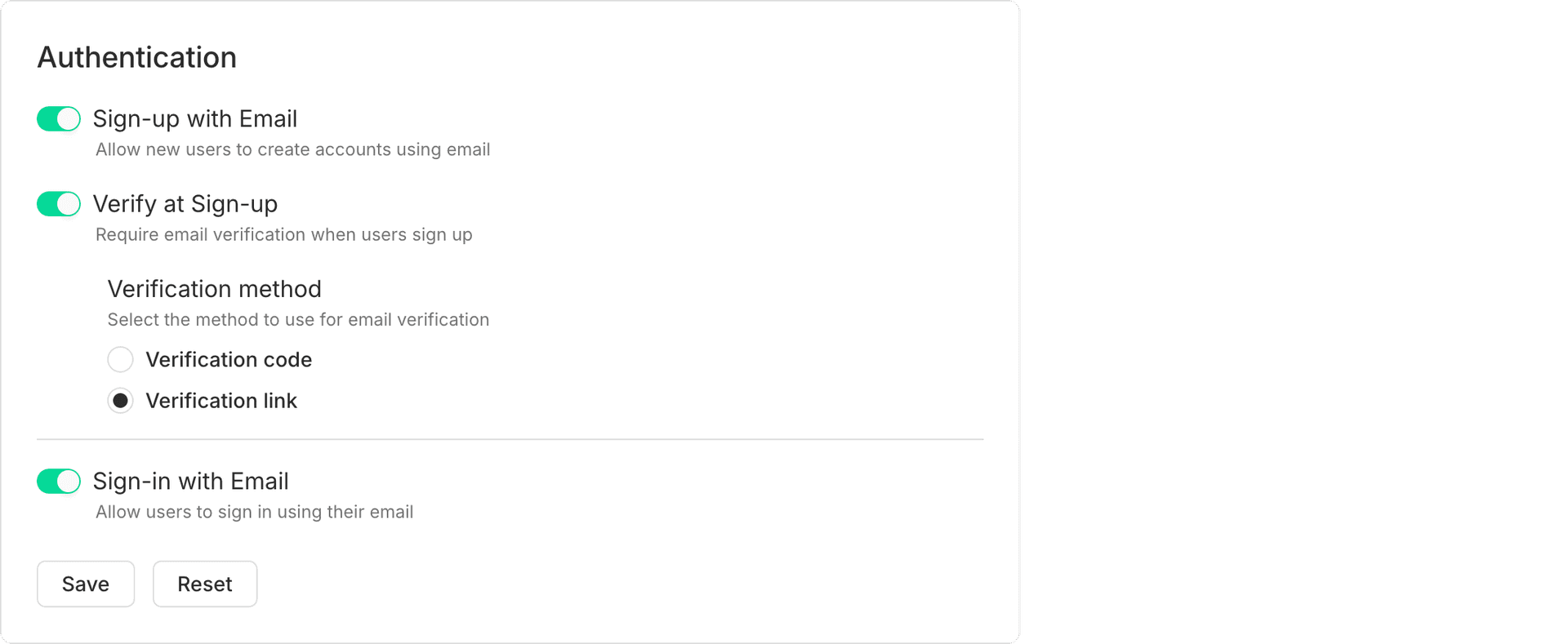
Verification links
Verification links require a custom email provider. See Email provider configuration to set this up.
When a user clicks the verification link in their email, the Neon Auth server handles verification and redirects them back to your application. Your app checks for the new session and shows the appropriate UI.
1. Check session on mount
Add a session check when your component mounts to detect when a user returns from clicking the verification link:
import { useEffect, useState } from 'react';
import { authClient } from './auth';

export default function App() {
  const [user, setUser] = useState(null);
  const [loading, setLoading] = useState(true);

  useEffect(() => {
    authClient.getSession().then(({ data }) => {
      if (data?.session) {
        setUser(data.session.user);
      }
      setLoading(false);
    });
  }, []);
}
2. Handle sign-up with verification
After calling signUp.email(), check if verification is required and show a message:
const handleSignUp = async (e) => {
  e.preventDefault();
  setMessage('');

  try {
    const { data, error } = await authClient.signUp.email({
      email,
      password,
      name: name || email.split('@')[0] || 'User',
    });

    if (error) throw error;

    // Check if email verification is required
    if (data?.user && !data.user.emailVerified) {
      setMessage('Check your email for a verification link!');
    } else {
      setMessage('Account created! Please sign in.');
    }
  } catch (error) {
    setMessage(error?.message || 'An error occurred');
  }
};
3. Check verification status
Access the emailVerified field from the user object:
const { data } = await authClient.getSession();

if (data?.session?.user && !data.session.user.emailVerified) {
  // Show verification prompt or restrict features
  console.log('Please verify your email to continue');
}
Verification codes
If you prefer verification codes, users receive a numeric code via email and enter it in your application. Your app switches between the auth form and a verification form.
1. Add verification state
Add state to track which form to show:
const [step, setStep] = useState('auth'); // 'auth' or 'verify'
const [code, setCode] = useState('');
2. Handle code verification
Create a handler for code verification:
const handleVerify = async (e) => {
  e.preventDefault();
  setMessage('');

  try {
    const { data, error } = await authClient.emailOtp.verifyEmail({
      email,
      otp: code,
    });

    if (error) throw error;

    // Check if auto-sign-in is enabled (default behavior)
    if (data?.session) {
      setUser(data.session.user);
      setStep('auth');
    } else {
      setMessage('Email verified! You can now sign in.');
      setStep('auth');
      setIsSignUp(false);
      setCode('');
    }
  } catch (error) {
    setMessage(error?.message || 'An error occurred');
  }
};
3. Show verification form
When step is 'verify', show the verification form:
if (step === 'verify') {
  return (
    <div>
      <h1>Verify Your Email</h1>
      <p>Enter the code sent to {email}</p>
      <form onSubmit={handleVerify}>
        <input
          type="text"
          placeholder="Verification code"
          value={code}
          onChange={(e) => setCode(e.target.value)}
          required
        />
        <button type="submit">Verify</button>
      </form>
      {message && <p>{message}</p>}
    </div>
  );
}
4. Switch to verification after sign-up
After calling signUp.email(), switch to the verification step:
if (data?.user && !data.user.emailVerified) {
  setMessage('Check your email for a verification code');
  setStep('verify'); // Switch to verification form
}
Complete example: App.jsx with verification codes
Here's a complete, minimal App.jsx file that includes sign-up, sign-in, and verification code functionality:
import { useState, useEffect } from 'react';
import { authClient } from './auth';
import './App.css';

export default function App() {
  const [session, setSession] = useState(null);
  const [user, setUser] = useState(null);
  const [email, setEmail] = useState('');
  const [password, setPassword] = useState('');
  const [loading, setLoading] = useState(true);
  const [message, setMessage] = useState('');

  const [step, setStep] = useState('auth'); // 'auth' or 'verify'
  const [code, setCode] = useState('');
  const [isSignUp, setIsSignUp] = useState(true);

  useEffect(() => {
    authClient.getSession().then((result) => {
      if (result.data?.session && result.data?.user) {
        setSession(result.data.session);
        setUser(result.data.user);
      }
      setLoading(false);
    });
  }, []);

  const handleSignUp = async (e) => {
    e.preventDefault();
    setMessage('');
    const { data, error } = await authClient.signUp.email({
      email,
      password,
      name: email.split('@')[0] || 'User',
    });
    if (error) {
      setMessage(error.message);
      return;
    }

    if (data?.user && !data.user.emailVerified) {

      setMessage('Check your email for a verification code');
      setStep('verify'); // Switch to verification form
    } else {

      const sessionResult = await authClient.getSession();
      if (sessionResult.data?.session && sessionResult.data?.user) {

        setSession(sessionResult.data.session);
        setUser(sessionResult.data.user);
      }
    }
  };

  const handleSignIn = async (e) => {
    e.preventDefault();
    setMessage('');
    const { data, error } = await authClient.signIn.email({ email, password });
    if (error) {
      setMessage(error.message);
      return;
    }
    if (data?.session && data?.user) {
      setSession(data.session);
      setUser(data.user);
    }
  };


  const handleVerify = async (e) => {

    e.preventDefault();
    setMessage('');

    try {

      const { data, error } = await authClient.emailOtp.verifyEmail({

        email,
        otp: code,
      });

      if (error) throw error;

      if (data?.session) {

        setSession(data.session);
        setUser(data.session.user);
        setStep('auth');
      } else {

        setMessage('Email verified! You can now sign in.');
        setStep('auth');
        setIsSignUp(false);
        setCode('');
      }
    } catch (error) {

      setMessage(error?.message || 'An error occurred');
    }
  };

  const handleSignOut = async () => {
    await authClient.signOut();
    setSession(null);
    setUser(null);
  };

  if (loading) return <div>Loading...</div>;

  if (session && user) {
    return (
      <div>
        <h1>Logged in as {user.email}</h1>
        <button onClick={handleSignOut}>Sign Out</button>
      </div>
    );
  }


  if (step === 'verify') {

    return (

      <div>
        {' '}

        <h1>Verify Your Email</h1>
        <p>Enter the code sent to {email}</p>
        <form onSubmit={handleVerify}>
          {' '}

          <input
            type="text"
            placeholder="Verification code"
            value={code}
            onChange={(e) => setCode(e.target.value)}
            required
          />{' '}

          <button type="submit">Verify</button>
        </form>{' '}

        {message && <p>{message}</p>}
      </div>
    );
  }

  return (
    <div>
      <h1>{isSignUp ? 'Sign Up' : 'Sign In'}</h1>
      {message && <p>{message}</p>}
      <form onSubmit={isSignUp ? handleSignUp : handleSignIn}>
        <input
          type="email"
          placeholder="Email"
          value={email}
          onChange={(e) => setEmail(e.target.value)}
          required
        />
        <input
          type="password"
          placeholder="Password"
          value={password}
          onChange={(e) => setPassword(e.target.value)}
          required
        />
        <button type="submit">{isSignUp ? 'Sign Up' : 'Sign In'}</button>
      </form>
      <p>
        <button onClick={() => setIsSignUp(!isSignUp)}>
          {isSignUp ? 'Already have an account? Sign in' : "Don't have an account? Sign up"}
        </button>
      </p>
    </div>
  );
}
Resending verification emails
Both verification links and verification codes expire after 15 minutes. Allow users to request a new one:
const handleResend = async () => {
  try {
    const { error } = await authClient.sendVerificationEmail({
      email,
      callbackURL: window.location.origin + '/',
    });

    if (error) throw error;
    setMessage('Verification email sent! Check your inbox.');
  } catch (error) {
    setMessage(error?.message || 'An error occurred');
  }
};
The server sends whichever type (verification link or verification code) you configured in the Console.
Required vs optional verification
When email verification is required in your Console settings, users cannot sign in until they verify. When verification is optional, users can sign in immediately but their emailVerified field remains false until verified.